Bleeding the Benefits Dry

The car-buying detail is good information but it’s landing in the wrong spot — tucked after what should be the emotional pivot toward the closing line, it reads like a footnote. It also slightly undercuts the “we’re done, we used the benefits” finality you’ve built.

Better placement is right after the billing reveal, before the wrap-up paragraph. Something like:

“Since we do need cars going forward, we were able to buy both of them — well-maintained, low mileage, good price. Toyota took care of them for three years so we didn’t have to.”

That way it feels like the last piece of the benefits puzzle clicking into place, not an afterthought.

Here’s the full draft with that adjustment:


Bleeding the Benefits Dry

My wife is about to “retire” from Toyota — and I use that word the way HR uses “restructuring.” She’s quitting. They’ll survive. We’re mostly just trying to make sure we don’t pay for anything on the way out the door.

Since we don’t know if the new insurance will be awesome, terrible, or a scavenger hunt where every doctor is mysteriously out of network, all my dental and eye appointments got yanked forward on the calendar. Prescriptions maxed out. The HSA accounts are running on fumes, which is exactly how Judy wants them. If there’s a responsible adult in this story, it is not me.

The last frontier is the vehicles.

At her level, Toyota Corporate expected the family to have at least one Toyota in the driveway — strongly suggested in the way where people notice what’s in the parking lot when you’re not allowed to work remote. Since we didn’t go for the biggest option available, we ended up with two. Both on leases Toyota paid for entirely. Lease payment, insurance, all maintenance. We don’t put many miles on either one. Most of what we do is within ten miles of the house, so after nearly three years, “maintenance” has mostly meant tire rotations and oil changes. I’ve spent a couple of mornings in the last two weeks taking care of exactly that.

This morning should have been the easy one. I made the appointment myself — last week Judy made it, which created a small hiccup I had to talk my way out of — and I showed up on time. They told me an hour and a half. The dealership sits right next to a park I’ve been walking regularly, so I put my earbuds in and set out to knock out four miles while I waited.

Somewhere past mile three, my phone buzzed. A video from the dealership — a technician walking around the car, narrating that everything looked fine. Maybe the cabin filter was a little dirty. Otherwise, good to go. If everything’s fine, why isn’t my car done?

I called the dealership number and worked through the menu until a perky AI picked up. She was more useful than I expected. She offered to forward a note to my service advisor. The note was expletive-free, so I let her.

A real person called back shortly after — not my service advisor, but a human nonetheless. She explained the holdup: the cabin filter. Did I want to approve replacing it?

I pointed out the obvious. Toyota pays for maintenance on this leased fleet vehicle. I don’t own it. I’m not paying for anything today. Am I really the right person to authorize a repair on a car that isn’t mine, for a bill I won’t see? She stayed on script but acknowledged the logic didn’t quite hold. She’d pass it along.

While that got sorted out, I finished my walk through a very active disc golf course. The trees and wind were keeping things interesting, and several signs reminded me the park accepted no responsibility for errant discs and the body modifications they might cause. It seemed like a reasonable time to head back.

My service advisor never did call. When I found him at his desk, he offered something in the mumble-mumble range that functioned as an explanation. I’ve had to defend the indefensible myself often enough to recognize the form. It bought him another fifteen minutes.

Before I left, he mentioned one thing worth the whole morning: if I’d been paying out of pocket today, the bill would have been about half of what Toyota was being charged.

Since we do need cars going forward, we were able to buy both of them — well-maintained, low mileage, good price. Toyota took care of them for three years so we didn’t have to.

We’re down to the last few things we can legitimately wring out before Judy’s final day. I’m not proud enough to say we got everything we could out of them — but benefits are there to be used, and we used them.

The new job is almost entirely remote. When she can work 95% from home, that beats a daily commute in a free car every single time. The real perk isn’t leather seats or free oil changes.

It’s not having to leave the driveway.
The Art of the Squeeze: Another Donor Day

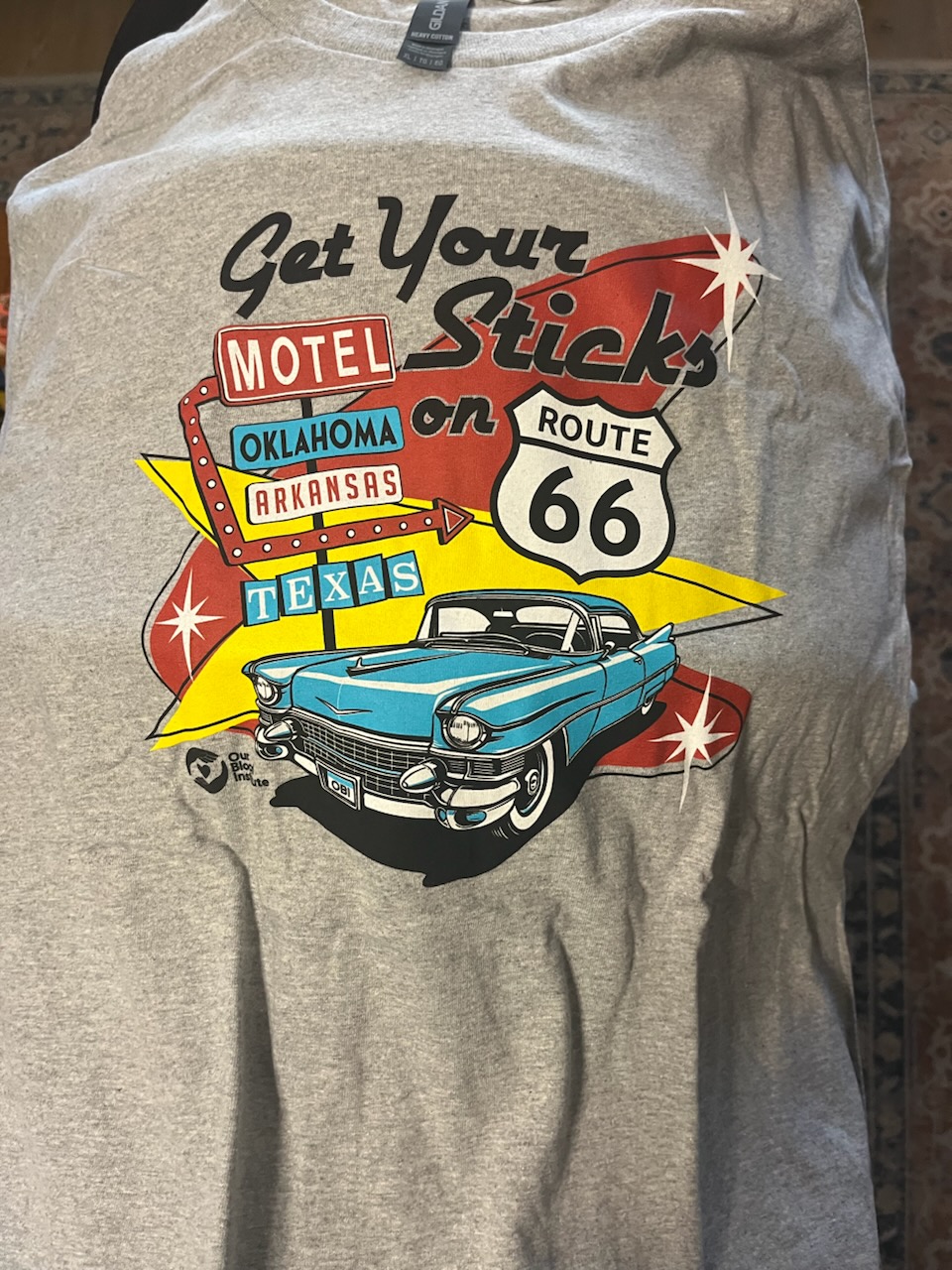
My new “Sticks on Route 66” shirt.

My double red eligibility opened up earlier this week — right on schedule, every sixteen weeks, whether the world needs me or not. I didn’t want to look like the guy who watches the schedule too closely, so I waited two days before heading in. Judging by the mood I walked in with, the staff probably wished I’d waited a couple more.

Before I left for OBI in Norman, I had to give our final hockey boy his end-of-season pep talk. I snapped a picture of him before I left so I could pretend I was still there when he actually walked out the door. The picture was taken a half hour too early. I am a scoundrel with no photographic ethics.

The older couple ahead of me at the front desk had arrived early. Fortunately, the staff member recognized my impatience and quickly got me into the screening room. I had a couple of lines I was proud of. When they asked if I’d ever donated under a different name, I said I usually go by Andrew, but sometimes Andy. When they asked if anything had changed since I completed the survey four hours earlier, I said I’d been briefly pregnant but wasn’t anymore. My slap-happiness does not always have good taste.

The screener, it turned out, works at the hockey rink. She has brothers who played out of state and were billeted at houses just like ours. Except the homemade pizza probably wasn’t as good.

Three people got involved once I was set up at the apheresis machine — the vampire machine, as I think of it, since it gives back what it doesn’t need.

The first got me settled in. Heating pad, arm pillow, squeezey toy. She handled the light work so the next person could focus on the vampire-specific functions.

The second was Hannah. I didn’t say Montana, but I thought it. She walked me through a recent FDA rule change: you now squeeze the toy the entire time, not just when blood is leaving your body. Apparently, the change was made to keep things straightforward for everyone. It does more than tickle when the flow reverses, by the way.

The TV had replaced the Power Rangers with American Ninja Warriors. One contestant was clearly training full-time for this at age 52. I thought about thinking something more critical, then remembered I was the guy who drove across town to lie in a chair and squeeze a toy. With the TV failing me, I studied the donor-recipient chart on the wall. My O+ can go to any blood type with a plus sign. I’m basically the Costco of blood.

The third had a paramecium tattoo on her left upper arm and a light blue bandanna. I’m not explaining it further. After the needle came out, she reached for the stretchy wrap and opened a drawer full of colors that would have had me deliberating for several minutes. She chose beige. It was the end of the roll, so I can respect that. But couldn’t I be special just once?

I settled in at the snack table with my Chex Mix and Gatorade, Nutter Butters tucked away to go. With my daughters out of the house now, setting them on the kitchen counter still brings back some fond memories — something to look forward to on their next visit.

So why do I throw two hours away watching things I don’t care about while surrounded by tattoos and piercings? It’s not the T-shirts, though “Get Your Sticks on Route 66” is genuinely good. It might be a little bit of my dad, who donated regularly — except he had hepatitis, which probably disqualifies the hereditary angle. Since he’s not around to ask, it still makes a good story.

When all the other reasons fall away, I’m healthy and able to, and that’s enough. When the cholesterol results show up in the OBI app, I smile and pat myself on the back for something I had no control over

I must like people at least a little. I married one.

The Trade-Off

Last night, our final hockey boy took me, my son, and his fiancée out to dinner. Judy was off on her own adventure, which meant I was the oldest person at the table by a comfortable margin and absolutely fine with that arrangement.

He picked Meddy’s, a Mediterranean place we’d been watching open up for weeks without ever actually going. Hockey schedules. Baby logistics. The couch. You know how it goes. But when the offer came, Meddy’s was the unanimous answer, and within about ten minutes of eating, we were all quietly annoyed at ourselves for waiting. Our first visit the previous week demanded this encore.

I got the lamb. Not something I’ve historically sought out, but this version — seasoned vegetables, crispy potatoes, a cilantro salad that overperformed — made a strong case. The only problem was the banana bread I’d eaten around four o’clock, back when dinner was still scheduled for 6:30. By the time we actually sat down, my stomach had already filed its paperwork. I did what I could and left the rest in a to-go box, fully intending to eat it for lunch the next day.

That was the plan, anyway.

The next morning, my son — one month out from his wedding, freshly relocated from his apartment — was heading to work. The coffee hadn’t quite landed yet. I looked at the fridge and, without a single moment of reflection, said: “You want my leftovers from last night?”

I expected a polite no. What I got was “Well, if you’re sure!” delivered with genuine enthusiasm, and honestly, what was I going to do — take it back? The box was gone. My lunch was gone. I stood there with the refrigerator open, staring at my backup options, which were not the same.

To his credit, he’d already eaten the same lamb dish as me at the restaurant the night before, plus half of whatever the hockey boy ordered — some salmon situation that sounded improbable and apparently tasted great. My son can eat! My leftovers went to an appreciative home, which is about the best consolation available when you’ve done something entirely to yourself.

But that wasn’t the part of the night I kept thinking about.

As we were wrapping up, the hockey boy asked to get out of the booth. He slipped away for a minute, came back, and handed me a gift card. “Since Judy couldn’t be here, I wanted to make sure she doesn’t miss out. Make sure you bring her back once she gets home.”

I’ve said before that teenagers aren’t always known for this kind of thing, and the hockey boys who’ve come through our house have been good kids — but “emotionally intuitive” isn’t usually the headline. This one is different. He’s not perfect, but he notices things, and he acts on what he notices, and that’s rarer than it sounds.

Our other boy aged out this season, so he’s done and onto college near his home in Wisconsin. This one, if he can get through the injury-trade-coach lottery that determines everything in junior hockey, we’re hoping comes back. We’d take him again without a second thought.

So yes — I gave away a perfectly good lunch for no reason. But I also watched a teenager think of my wife before I did.

Some trades are worth it.

All Dressed Up and Nowhere to Vote

I had a freshly minted Oklahoma driver’s license and a new voter ID card sitting in my wallet, and they were starting to feel impatient.

I wasn’t about to run a stop sign just to manufacture a reason to flash them at law enforcement. An election seemed like the safer route for everyone involved.

Springtime in Oklahoma usually means there’s a primary or some hyper-local issue pulling citizens to the polls. Moore was holding one — a single item on the ballot: permission to raise the sales tax a full percentage point. Effectively, a quarter more every time someone off I-35 feeds their family at the Chick-fil-A. The city thought they made a compelling case. A tax is a tax, and I rarely play along with these schemes.

My polling place turned out to be a church connected to the walking track I use most mornings. Despite my brave outward appearance, I am a fragile creature held together by avoidance and minimum human exposure — which is why I walk the track instead of the neighborhoods, where barking dogs and leaf blowers would require constant earbud adjustments, and I’d arrive home worse than I left. But this felt elegant: leave the path mid-walk, vote, return home on foot. Zero carbon emissions. Maximum civic righteousness. Superior plan.

The church was a ghost town.

The only sign of life was a janitor with LED spelunking gear strapped to his forehead. Because Oklahomans are terminally friendly, he didn’t just tell me the poll workers hadn’t shown up — he shared his entire political manifesto. Didn’t see any signs when he came in, which told him everything. Votes absentee. Not a fan of tax increases. Voted against it himself. Since this was a City of Moore issue, he suggested I contact them directly.

Back home, I worked through the list of alternate polling locations. When clarity remained elusive, I called. The receptionist needed some convincing that an election was actually happening today. Once she accepted the premise, she reflected, “I did see a few extra people around.” A few questions later, I had my answer: my zip code says Moore, but my street address only piggybacks on it. I live in the county. Not a Moore resident.

My credentials never left my wallet.

New working theory: if I’m voting on anything state or national, the church on the walking track is my spot. If the ballot involves Moore taxing out-of-towners — well, the measure failed 56 to 44. They didn’t need me. The chicken sandwich survived.

The Knight Takes a Different Street

If you read last week’s post, you know I wandered into two strangers’ yard, dispensed unsolicited landscaping advice, and left feeling like I’d done something useful. I also gave them hockey tickets, because apparently I was in a generous mood and hadn’t yet learned my lesson.

The tickets didn’t work out.

I was at the grocery store Saturday afternoon when she called. Their HOA had issued an ultimatum — something involving condemnation proceedings, HOA jail, or possibly being forced to live in their dispensary. I’m fuzzy on the exact bylaws. The panic, however, was real, and the solution was an emergency run to Tulsa for a trailer full of sod. She felt terrible about the tickets and wanted to make sure it was okay if someone else used them. I told her, of course, and that she was being more conscientious about free tickets than I ever would have been. Her guilt was running at a much deeper level than the situation required.

Knowing one of them has a bad back, a sod run sounded like a terrible idea. But they had a plan, and me adding unsolicited opinions to their plate wasn’t going to serve any purpose. Good on them for having a plan at all.

What I didn’t know was that the universe had already logged my next move.

Easter evening, I went for a walk — solo, audiobook loaded, no agenda. My son and his fiancée went a different direction. I made a small adjustment to my route. I now understand this as my first mistake.

I turned onto their street just as they were staring down the second of two pallets in the trailer. Four pallets total, two days of work — this was just a fraction of the pain, and they were already operating on fumes. I had options. A tactical retreat was available. Reversing my path before eye contact was made remained technically possible.

I did not take my options.

“I wouldn’t be much of a gentleman if I left you to finish this by yourself.” They tried to wave me off. I borrowed some gloves and got to work.

The first several rows went fine. I loaded the hand cart; they wheeled it over and unloaded; and then, I grabbed a couple of loose rolls in the meantime. We chatted. I asked if their friends ended up liking the game. They didn’t go either. The tickets had now failed two sets of people in one evening, which felt like a record. They kept thanking me, and since the only adequate response was to actually finish the pallet, I stayed focused on that.

Sod operates on a cruel law of physics. The pallets used a standard Lego stacking principle — two rows of five left to right, two rows of five up and down — and the lower I went, the heavier each roll became. This may have been the physics. It may have been me. I didn’t investigate too closely. The trailer walls felt like they were narrowing. The ceiling felt lower than it had been. I was taking longer breaths between rolls, doing a controlled squat my knees were filing complaints about, and wrestling each roll into position so it wouldn’t unravel on me before I could get a grip.

By the last two rows, I’d stopped pretending to be efficient. I just shoved them to the back lip of the trailer so they’d be easier to reach. I told myself this was strategy. I let that stand.

When the last roll came out, it about killed me. The good kind, I think.

I asked if they needed help with the pallet itself. They did not. They thanked me at a volume and sincerity level that was probably appropriate to the situation and possibly flattering to my ego. I started the walk home.

My clothes were dirtier than an Easter stroll should produce. My gait had become something I’d describe as a waddle, which my “muss-kulls” — what I call my muscles when they’re tired, overused, and acting thick — were working to correct one awkward step at a time.

Judy looked at my socks when I came in. “What happened? Are you okay?”

I told her none of it was blood. I told her I’d rather be known as someone who helps than someone who watches. I believe that. I also believe there’s a line between good neighbor and slightly creepy yard stalker. Unloading sod for people I’ve shaken hands with exactly once is, at minimum, unusual.

Their landscaping nightmare isn’t close to finished. They still have to till the dead grass, put down topsoil, grade the whole thing, and actually lay the sod. But my work in their yard is done. I know a route adjustment that’ll save me considerable time and laundry. Should the knight in me feel the pull to rescue the maidens again, I’ll choose a different street — just to remove the temptation.

A man has to know his limits. Especially on Easter.

Oklahoma Hockey (and Other Natural Disasters)

Oklahoma weather forecasters don’t give you a report — they give you a threat assessment. A full week out. Not “bring an umbrella.” More like “settle your affairs and consider your roof a temporary situation.” We’re talking atmospheric tantrums that halt air travel, reroute rivers, and occasionally redecorate entire zip codes. I’ve lived in the South long enough that Ohio has some catching up to do, but Oklahoma still plays in its own division — the one where the meteorologists have agents.

Friday night was billet appreciation night at the Warriors game. It was exactly that. It just came with an unscheduled intermission.

The evening started with a charcuterie spread and adult beverages — a social event, not a meal, which is a distinction that matters when you’re trying to justify the brie. Judy and I were mostly there to spend time with the mother of our age-out boys. The year a player turns 21 is the end of his junior hockey career — and the end of his time with whatever family took him in. Crowds aren’t really my preferred operating environment, and I didn’t know most of the people there, which meant I got to perfect my “engaged bystander” expression for the better part of an hour.

The Warriors came out and went up 2-0. As the last team to squeeze into the postseason, this was not how anyone expected them to play. The backup goalie was in net. Nobody cared. The lead was everything.

Between the first and second periods, all the billet families walked out onto the ice. The boys skated over to whoever feeds them and does their laundry, a photographer snapped pictures, and each family received a personalized engraving — “Gruenbaum” was the name etched into our Warriors billet family keepsake. Genuinely lovely gesture. Also, not the reason anyone is doing this. Nobody stands in their guest room — the one now permanently scented with hockey equipment and teenage ambition — and thinks, you know what would make this worth it? A tasteful engraving. The season tickets and monthly stipend do the actual persuading. The engraving is the cherry on top of the “I have a teenager living in my guest room” sundae. A very nice cherry. But still.

The second period had good hockey. Our boys were competing.

Somewhere between the second and third periods, while the crowd watched chuck-a-puck, my phone buzzed. Tornado warning. My first instinct was purely structural: we’re in a large, well-constructed building, they’ll just keep playing. This is what years of Oklahoma meteorology does to a person — they scream wolf so enthusiastically, so consistently, that eventually you stop flinching and start quietly rooting for the wolf just to see how it plays out.

Then our son called. He’d forgotten we were at the game, but since he was near our house, he wanted to use our storm shelter. Permission granted. Good kid. Efficient crisis management.

The arena announcer — who normally delivers commentary at a frequency only retrievers can decode — was suddenly, remarkably, comprehensible. “Leave your seats now and make your way under the bleachers. This is not a test.” The crowd moved efficiently, calmly, without drama. In Oklahoma, a tornado warning is less an emergency and more a scheduling inconvenience.

Judy had more urgency than most. She was ahead of me almost immediately, and by the time we reached the concourse I’d lost her in the crowd. I checked the rooms along the hallway under the bleachers, doing a quick inventory of the available Judys, which came up short.

Under the bleachers, the true Oklahoma spirit revealed itself. Someone nearby announced, loud enough for several people to hear: “I hope the tornado doesn’t mess up my Amazon delivery.”

Cell signal was rough, so anyone who had it became an involuntary broadcaster — announcing radar updates to whoever was standing close enough to hear. The murmuring started: How long would they keep us down here? Would they wait out the full watch? Would the game even finish? Then a guy who had clearly aced every weather-related exam Oklahoma had ever administered worked his way through the crowd and told everyone to head back to their seats. No report on what happened to the west. No update on what occurred to the east. The information was: go sit down.

The Warriors finished the night with a W. The tornado moved on to inconvenience someone else. And somewhere nearby, a Ring camera confirmed that a package survived the whole ordeal without incident.

The Pudding Aisle

My daughter and I had a cooking project last Tuesday. She went through my “make these someday” recipe stack, picked her favorite, and we drove to the store to collect what we needed.

I always end up in the pudding aisle.

I’m a pudding voyeur from way back. Pre-COVID, the butterscotch section alone gave me options — store brand, off-brand, multiple sizes. Now it’s just Jell-O, one size, take it or leave it. I leave the chocolate lovers their big box. I don’t need to understand them.

The cook-or-instant question isn’t really a question. Pudding is not meant to meet cold milk in a bowl and get stirred into submission. It’s meant to dirty a pan. It’s meant to thicken slowly while you stand there wondering if you’ve stirred constantly enough to avoid burning it. There’s a small gamble involved, and I appreciate that in a dessert. If you reach for the instant box, you’ve already answered something about yourself.

My daughter — the one I babysit for — has been known to locate the butterscotch box sitting in my cabinet, waiting for someone with patience and standards. I’ll make it for myself if I have to. But knowing someone thinks me worthy of a cooked product is a better feeling than I probably should admit.

Way back when my wife and I were dating, my future mother-in-law bought me a butterscotch pie. To make me feel welcome, I think. She didn’t bake it herself, which, in retrospect, was the correct level of effort for someone who hadn’t decided about me yet. I didn’t make nearly enough of a fuss over it — being a young man of profound emotional stupidity, I offered the bare minimum of gratitude. I’m making up for it now by gatekeeping the pudding aisle. It’s called growth.

I used to make homemade butterscotch pudding too, in the double-boiler era. Every recipe I look at now just says “saucepan.” If you’re currently content with the pre-made plastic-cupped pudding from the refrigerated aisle, I’m not angry. I’m just disappointed.

Many of my taste preferences have shifted over the decades. The butterscotch ones have not moved an inch. They remain loyal, patient, and occasionally indulged.

And I probably shouldn’t mention this, but my granddaughter tried a small spoonful the other day. The look on her face was familiar. I’m choosing to believe it’s genetic.

Yesterday Was a Good Day

Yesterday was a good day. Not the day off I pictured when I took this job (it isn’t an actual day off, but we pretend), but a good day.

When I signed on as the primary caretaker for my granddaughter, the wins were simple. Bottle finished. Burp achieved. Dry diaper confirmed. The job description fit on an index card.

It doesn’t anymore.

Now, a good day means I kept her entertained long enough that she went down for her nap without excessive drama. It means everything ran on something resembling a schedule, because the adults in her life are trying very hard to pretend their lives aren’t a complete shipwreck since she arrived. It means I successfully assessed which objects on her high chair tray were unlikely to choke her, a calculation made more interesting by the fact that God has not yet seen fit to give her teeth.

The surveillance portion of the day is non-negotiable. We walk laps — kitchen, living room, hallway, back to kitchen — while she conducts a thorough inspection of everything that has changed since her last walk. Usually, nothing has changed. She checks anyway.

Outside, it’s the mulch. The brown mulch in the flower beds has captivated her in a way I cannot fully explain. It fits perfectly in her little fists. Also in her mouth, which is where most things end up. Her appetite operates on one schedule: eyes open.

A good day also means I timed the diaper change correctly. Change her, set her down in the living room, execute the strategic maneuver of leaving the bathroom door open, and move with purpose. If the math works out, I’m washing my hands when her little crawling body appears around the door frame, just making sure I’m not having an adventure without her.

Then there are the moments that have nothing to do with logistics.

The reluctant laugh — the one where her tummy figures out she’s ticklish before she’s fully committed to the idea. The way she sticks her chest out when you hold her hands, and she leads you, with great authority, to all the important places that require daily review. The diaper bag left unzipped for thirty seconds, which is thirty seconds too long, and the full excavation that follows. She’s looking for something. We don’t know what. It goes in her mouth.

She has also discovered my glasses. There is a game now — I didn’t name it, she invented it — where she removes them from my face with the focused determination of someone defusing a bomb. I’m usually holding her because she’s in a pre-nap mood, which means I’m also the only available entertainment. The lenses are a mess. It’s fine.

There’s also the nap itself, which raises its own question: when she wakes up crying after forty minutes, is she actually awake, or just passing through? The answer determines whether I have time to start dinner. I have not yet developed a reliable system.

The job description has changed, but so have the fringe benefits. She has a personality that walks into a room before she does. The diapers are worse, the opinions are louder, and she has a will that I respect even when it is aimed directly at me.

But I get to watch a little human discover herself. Every lap around the kitchen, every fistful of mulch, every reluctant laugh — she’s figuring out what the world is.

She’s not the only one.

The Self-Appointed Yard Whisperer

This is a further explanation of one of the titles included on my “semi-retired” business card. (Mulch Magician)

My wife was out of town again, which meant dinner was whatever was in the fridge that could survive a second heating. After staring at three containers of uncertain origin, I decided a walk was a better option than food poisoning roulette.

I had an audiobook. I had a route. I had a text out to my son one street over, which he was apparently in no hurry to answer. Fine. I walked.

About ten minutes in, I spotted a couple of women in a front yard — one holding a hose aimed at some trees that had clearly given up, the other supervising from the porch with a German Shepherd on a leash. I crossed the street to say hello, because apparently that’s the kind of person I am.

The dog was skeptical. Her owner told her several times I was fine, then shook my hand in front of her as a formal introduction. The dog considered this, leaned in, and licked my hand. Endorsed. I was in.

What followed was a twenty-minute conversation I had absolutely no business being part of, and yet somehow led.

The trees had been pruned badly — topped, actually, which is basically a death sentence delivered slowly. The grass was Bermuda sod laid in December of 2021, right before they moved in. They moved from Seattle, where watering the lawn is something God handles for free. They waited for spring. Spring, in any meaningful grass-growing sense, never came. They’d tried a series of quick fixes that the yard had rejected with contempt.

I suggested weed mat and perennials for the flower bed. I floated the idea of waiting until fall to deal with the grass. I cautioned them about ordering a truckload of dirt before a rain. I was, by any objective measure, a complete stranger who had wandered in off the sidewalk and was now running a landscaping consultation in their front yard.

At some point I said something like, “I could come help you with some of this.” Then I heard myself. First meeting. Showing up with unsolicited yard opinions is one thing. Showing up with a shovel is how you become a story someone tells later.

Then one of them mentioned they’d found a drug pipe on top of the kitchen cabinets when they moved in.

“That’s not good,” I said.

“We don’t smoke it ourselves,” she said, “but we own a dispensary. So our main question is — what exactly were they doing while they were high in our house?”

Apparently, one of the answers was fixing the door latch — with notebook paper stuffed around the strike plate. High-effort, low-intelligence engineering that you can only pull off when a glass pipe is involved.

My son called during all of this. Then called again. I let it go. He would understand. He’d seen me do this his whole life — stop to talk to a stranger when someone who knows me is technically available. And honestly, I’d just seen him the day before. The women with the dying grass and the drug pipe had never met me. They needed me more.

Toward the end, something clicked. I asked if they happened to be hockey fans. They loved the Kraken (Seattles Pro Team). I told them about the rink just off I-35 south of 240, the boys who live with us, and the extra tickets we pass out to potential fans.

The two of them looked at each other. Nodded. Already knew who they were inviting.

I walked home with no audiobook progress, a missed call from my son, and the quiet satisfaction of a man who had done exactly what he set out to do — even if he hadn’t known what that was when he left the house.

Maybe it was the yard advice. Maybe it was the hockey tickets. Maybe it was just better to talk to absolute strangers than to call someone who’s heard all my material before.

The trees are still lopsided. But I’ve got fans to cultivate.

Almost Okie

Today, an era ended. I officially traded my Texas swagger for an Oklahoma “Okey-dokey.”

I switched my driver’s license.

I walked in, sat down in front of a woman, she looked at my papers, and sent me to the one chair reserved for photos. Barely 15 minutes from entry to exit. Three miles from my house. No app telling me when I was allowed to show up. No line snaking through a building the size of an aircraft hangar.

In Texas, you schedule days out — months if a driver’s test — and pray the system doesn’t go down on your day. If it does, you haven’t wasted a whole day. You’ve wasted a whole day and your will to live. There’s a substation near most Texas neighborhoods for plates and stickers, but for a license? You’re probably driving 25 minutes to the mega-processing center and clearing your calendar. Here, I had the choice of many locations. The office I chose handled everything. One stop. One very efficient woman who probably wished I’d stop complimenting the process.

The guy behind me had his required documents on his phone. He emailed them to the nice lady and they printed them for him. Both methods work. One involves planning ahead. I’ll let you guess which one I prefer.

I did not ace the eye exam. I want to be clear about that. I passed — barely — but I read the “just a line short of blind” line, and apparently that’s good enough to drive. Nobody seemed alarmed. I appreciated their restraint.

They also gave me genuinely useful advice: go for the 4-year license instead of 8, because renewal is free after 65. In Texas, I might have paid extra just to avoid coming back. Here, I almost want to return.


We’ve lived in Oklahoma for almost a year and a half. My wife was still technically on a Texas payroll — with perks tied to her Texas address — which gave us a convenient excuse to keep the fiction going a little longer. When that chapter closed and a new opportunity let her be honest about where she actually lives, the last reason to delay went with it.

So I kept the Texas license. Not for legal reasons. For sentimental ones.

As long as it was in my wallet, I was still a Texan. There’s a low-grade smugness that comes with that, and I hadn’t realized I was addicted to it. I liked our community, our neighbors, the restaurants we knew by heart. Oklahoma has been kind. Oklahomans are genuinely good people. But we haven’t found our Mexican place yet, or our Italian place, or the one spot we’d drive across town for without discussing it first. My wife asked where I wanted to eat recently and I said Chick-Fil-A. She wanted somewhere nicer. Neither of us could name it. That’s the whole problem right there.

The restaurants will come. I know that. My patience just didn’t get the memo.

The real reason I finally made the switch: I want to vote here. We watch Oklahoma primaries and bond issues play out on TV and I have no voice in any of it. I’ve said for years that if you don’t vote, you can’t complain. I meant it. Time to get in the ring.

So now I’m an Okie. Officially. I’ve got the license to prove it, and I only had to squint a little to earn it.