The Sarcasm Sabbatical

When her dad leaves, it’s just the two of us.

She doesn’t cry. She watches the door for a moment, then turns those big brown eyes toward me like she’s decided I’ll do. I reach out my hand and she puts hers in it. Just like that. No negotiation, no hesitation. She’s in.

I don’t deserve that.

Not because I’m a bad person. But because twenty minutes earlier I was mentally rearranging my morning, calculating what I could still get done with her here. A guy who does that doesn’t deserve to have a ten-month-old place her hand in his like he’s the most reliable thing in the room.

If I could summon any sarcasm in that moment, I’d shut it down fast. It has no place there. She wouldn’t understand it anyway, but that’s not why. It’s because sarcasm requires a little distance, a little edge — and she’s handing me something that has none of either.


Sarcasm has been my first language for as long as I can remember. Not the cruel kind — I want to be clear about that. More like a filter. The world comes in, gets processed, and comes out with a slight lean. A raised eyebrow you can hear.

My wife has spent thirty-plus years either appreciating it or tolerating it, depending on the day. My kids grew up fluent. Visitors to our house occasionally need a translation.

It’s not a defense mechanism. I’ve heard that theory. I just like it. It keeps things from getting too precious. Life has enough earnest moments without me adding to the pile.

I’ve never wanted to be the guy who buries his wit in a bowl of warm oatmeal. Still don’t.


Something is happening, though. I notice it in small doses.

She’s been in my life less than a year and the near daily exposure is doing something to my defaults. I’m slower to reach for the raised eyebrow. Quicker to just… be there.

Some of it is age. Some of it might be spring. I’m leaving room for the possibility that July heat brings it back in full force and this whole reflection was seasonal.

But some of it is the memory problem. I ran on fumes through a lot of my kids’ childhoods. Work, dinner, bedtime — repeat. I don’t have the sequential recall I wish I had. Ask me to walk through any one of my kids’ early years in order and I’m zig-zagging between fragments, hoping the effort knocks something loose.

I’m paying attention differently now. She’s clearing her first-year hurdles and I’m watching every one. Maybe that’s what’s crowding out the sarcasm. Hard to maintain the slight lean when you’re actually trying to catch everything.


I want to be clear about something. I’m not trying to shed the sarcasm. I’m not in recovery.

I like those shoes. I like walking through life as the guy with the quick smile and the wit already three steps ahead. It has served me well. It has made hard things bearable and dull things entertaining. My wife knew what she was signing up for. Mostly.

But a ten-month-old with big brown eyes who puts her hand in mine without a second thought — she’s not asking me to change. She just doesn’t leave room for it. The distance that sarcasm requires isn’t available when someone that small is trusting you that completely.

So for now, in those moments, I put it down. Not permanently. Just in the corner, where I can find it when she goes home.


Her mom picks her up and the house goes quiet in a specific way that it didn’t used to.

I don’t immediately reach for the wit. It comes back gradually, like eyes adjusting to light. By dinner I’m probably back to full strength. My wife would confirm this.

But something lingers. I’m not sure what to do with that yet. Maybe nothing. Maybe it’s just what happens when someone tiny and completely earnest spends enough time in your house.

Ask me again in August. If the heat is up and the sarcasm is fully restored, we’ll call it seasonal.

If not, I’ll let you know.
Mostly Harmless: A Defense of the Kind-Hearted Annoyance

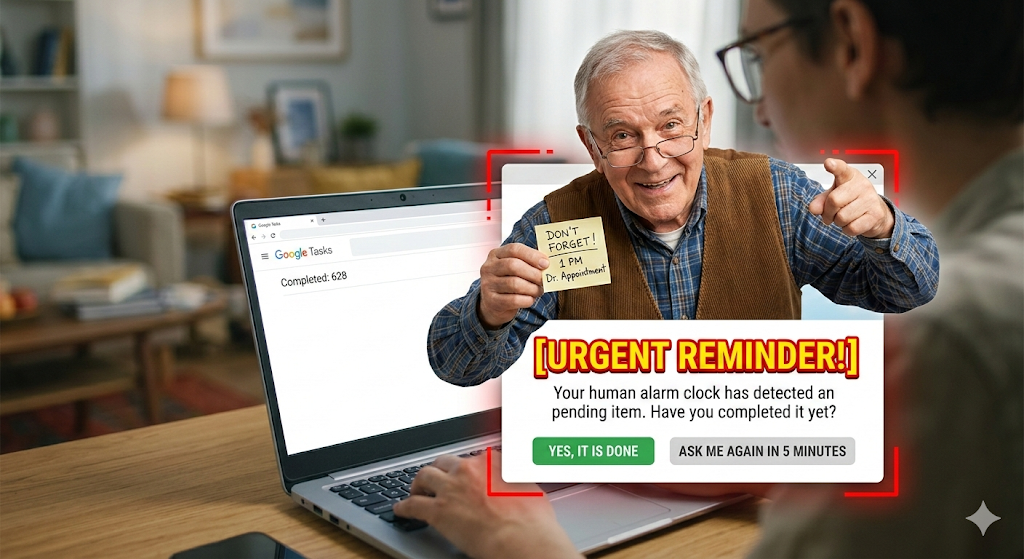
This is a further explanation of one of the titles included on my “semi-retired” business card. (Reminder Wrangler)

My wife has a habit of looking at me and saying, “Can you remind me to call so-and-so tomorrow?” or “I have a doctor’s appointment; don’t let me forget.”

She seems to believe I have a dedicated “Spouse Schedule” processor running in the background of my brain at all times. In her mind, she’s delegating a task. In my mind, she has just hit “Install” on a piece of high-persistence malware.

Being a human reminder is a high-stakes game. It comes with two distinct curses: the crushing dread of forgetting, and the social suicide of over-reminding.

The “Nag” Sacrifice

Admittedly, smartphones have chipped away at my market share. But even in a world of haptic feedback, I still find ways to offer my “invaluable” services. As I’ve grown older, I’ve become so committed to the role that I have officially slipped into the “nag” category.

I am a human pop-up ad. I am the “Update Required” notification that you can’t swipe away. I have willingly tanked my reputation, descending into that murky social basement occupied by influencers and other bottom-dwellers of the untrustworthy food chain.

Why do I make this sacrifice? Because when she says “Remind me,” it is a binding contract. That initial charge supersedes any later, frustrated comments like, “Okay, you can stop reminding me now!” I bought in until the objective was completed, honey. I’m a shareholder in this phone call now. Why can’t you stay as committed as I am?

The Glory of the Checkbox

I understand she has a full-time job and “life distractions” that are several priority levels above our current joint focus. But for me, the task stays on my mental dashboard until the very last second.

I can’t take it off the list until I look at her and start to open my mouth. Usually, before a single syllable escapes, she snaps: “It’s done. Okay?”

Victory. With that comment, I get to check two boxes. First, the “self-tickler” part of my brain finally stops itching. Second, and more importantly, I go to Google Tasks and watch my “Completed” count climb from 627 to 628. For a semi-retired grandpa, that is a statistical triumph worth celebrating.

Bring Back the Nag

My life isn’t overly complicated, and I like it that way. It’s these small, irritating transactions that give me value.

While your phone may give you a reminder from the cold obscurity of a pocket, you should consider bringing a kind-hearted nag back into your life. We are mostly harmless, we take your chores more seriously than you do, and we only want the best for you—mostly so we can finally stop thinking about your dentist appointment and move on with our lives.

The “Get-To” vs. The “Have-To”

I’m currently coming off a 60-day streak from my other blog, and I’m protective of that momentum. With “Grandpa’s Daycare” eating up about 30 hours of my week, I never truly know which day will be the one where the wheels fall off. My goal for this past weekend was simple: bank a three-day buffer of posts so I could breathe.

I missed that goal by 100%.

It started Saturday at 4:30 AM with an airport run for my wife. Here’s what 4:30 AM looks like: three cars on the road, darkness that makes 7:30 AM look like high noon, and a version of me with zero sarcasm loaded. I’m a sarcastic person by nature — it’s basically my factory setting — but apparently it doesn’t boot up until after sunrise. My wit didn’t come back online until I was halfway home, alone, with no one to appreciate it.

That low-grade exhaustion shadowed me the rest of the day. My son and his fiancée came over for quality baby time, and my job quietly shifted. My future DIL is anxious to start her own family, so when she’s in the room, my grandpa instincts take a back seat. My real role became reading the baby’s cues and redirecting — making sure the DIL banked every possible minute of the Ellie experience she craved. I’m not just watching my grandkid grow. I’m watching my future family grow.

I wasn’t exactly winning “Host of the Year,” but the baby stayed alive, so I’ll call it a win.

Then came Sunday. And the Eggplant Experiment.

My son wanted to make Eggplant Parmesan, which — fine. Noble ambition. The problem was his vision was… limited. One small eggplant will not feed a crowd. Bread it, fry it, done. No sauce. No provolone. No oven time. Now, most of his cooking lives in the Instant Pot or air fryer, clean and contained. Hand him a pan and grease, and you’ve introduced variables: splatter, smoke, and a look on his face that says he’s improvising in real time. Sensing a nutritional void and a quiet anti-eggplant contingency in the house, I scrambled. I resurrected some chicken parm from Thursday night, prayed I could add enough juiciness to make the “recycle” respectable. By then, the endless volley of “Where is the…?” and “How do I…?” questions had made any hope of retreating to my den to bank those blog posts evaporate.

Dinner blurred for me. After the dishes were cleared, my reward for the day was another airport run to pick up my wife. I felt a little guilty about leaving the house mid-activity, told the kids so, and then spent the drive enjoying fifteen minutes without anyone asking me where anything was. Getting her home before 8:30 PM is a world better than an 11:00 PM pickup. Some wins are quiet.

Later, sitting with zero banked posts and approximately zero relaxation, I chewed on that question from my future DIL — something rooted in our faith, about whether certain things we’re called to do feel more like obligation than privilege. “Do you get it?” The contrast she was drawing: some things in the Christian life aren’t always fun, but with the right mindset, you get to participate in something most people don’t even realize is available to them.

As I thought about this question, I reviewed my weekend. Do I get it?

Yes. I get a life so full of stories I don’t have time to write them all. I get to be a dad and a granddad multiple times a day. I get to cook for people I love — and not every time I do, do I feel grateful, I’ll be honest. But if I have to cook anyway, I might as well frame it as a “get to” rather than a “have to.” The food tastes the same either way. The choice is just which version of yourself shows up at the table.

When you’re exhausted, it can all feel like a “have-to.” But it’s a “get-to” that most people would pay a premium for.

Big Bones and the BMI That Never Stood a Chance

My mother always had an explanation ready for why I never fit the BMI chart. She didn’t need science or statistics — she had something better: maternal confidence. She’d look at me, shrug like it was the most obvious thing in the world, and say, “You just have big bones.”

That was her entire medical opinion. No copay required.

And honestly, she wasn’t wrong about the spirit of it. I’ve never fit the chart. Not as a kid in a small Christian school where the gene pool was basically a puddle. Not in the country high school where the puddle got wider but not deeper. Not even after Basic Training, when I briefly achieved the closest thing to “normal” the BMI would ever allow.

My job growing up was simple: be big, look athletic enough, and protect my brain from whatever forces were trying to keep it from reaching its potential. After Basic Training, the weight came back like it had been waiting in the car the whole time. It’s been remarkably consistent ever since. My clothes from years ago still fit. My doctors have stopped giving me the “you should lose some weight” speech. At this point, my body is about as predictable as my electric bill or my bedtime.

Somewhere along the way, I realized that not fitting the chart doesn’t mean something is wrong with you. Sometimes the chart just wasn’t designed with you in mind. Sometimes the chart is wrong. Sometimes the chart needs to mind its own business.

Everyone has something that knocks them out of the norm. Mine just happens to be visible on a scale. Yours might be hiding in your personality, your habits, or that one hobby you don’t tell people about until you know them well enough.

These days, my attempts to lose weight fall into the “sure, why not” category. Occasionally I even “sympathy diet” with my wife when she decides she likes food more than me — which isn’t true, but chocolate is a close second. Mostly, though, I’ve learned to lean into the areas where I can be judged on merit instead of metrics created to make everyone feel like they’re supposed to fit into the same box.

I’m not my BMI. I’m not my weight. I’m not even my mother’s “big bones,” though I’ll admit the line has aged surprisingly well.

So no, I don’t fit the chart. I probably never will. But the chart never really knew what to do with me anyway.