The Pudding Aisle

My daughter and I had a cooking project last Tuesday. She went through my “make these someday” recipe stack, picked her favorite, and we drove to the store to collect what we needed.

I always end up in the pudding aisle.

I’m a pudding voyeur from way back. Pre-COVID, the butterscotch section alone gave me options — store brand, off-brand, multiple sizes. Now it’s just Jell-O, one size, take it or leave it. I leave the chocolate lovers their big box. I don’t need to understand them.

The cook-or-instant question isn’t really a question. Pudding is not meant to meet cold milk in a bowl and get stirred into submission. It’s meant to dirty a pan. It’s meant to thicken slowly while you stand there wondering if you’ve stirred constantly enough to avoid burning it. There’s a small gamble involved, and I appreciate that in a dessert. If you reach for the instant box, you’ve already answered something about yourself.

My daughter — the one I babysit for — has been known to locate the butterscotch box sitting in my cabinet, waiting for someone with patience and standards. I’ll make it for myself if I have to. But knowing someone thinks me worthy of a cooked product is a better feeling than I probably should admit.

Way back when my wife and I were dating, my future mother-in-law bought me a butterscotch pie. To make me feel welcome, I think. She didn’t bake it herself, which, in retrospect, was the correct level of effort for someone who hadn’t decided about me yet. I didn’t make nearly enough of a fuss over it — being a young man of profound emotional stupidity, I offered the bare minimum of gratitude. I’m making up for it now by gatekeeping the pudding aisle. It’s called growth.

I used to make homemade butterscotch pudding too, in the double-boiler era. Every recipe I look at now just says “saucepan.” If you’re currently content with the pre-made plastic-cupped pudding from the refrigerated aisle, I’m not angry. I’m just disappointed.

Many of my taste preferences have shifted over the decades. The butterscotch ones have not moved an inch. They remain loyal, patient, and occasionally indulged.

And I probably shouldn’t mention this, but my granddaughter tried a small spoonful the other day. The look on her face was familiar. I’m choosing to believe it’s genetic.
Feeding the Ungrateful

The first night with a new hockey player, we made pasta with roasted cherry tomatoes. He had told us beforehand, “I eat everything.” After dinner, he quietly revised that to “everything but tomatoes” — with the look of someone who’d just been served a plate of gravel. Good to know. Lesson learned.

We have been feeding a rotating cast of hockey players, exchange students, and our own four kids long enough to know that the dinner table is not a democracy. It’s a negotiation, and we are usually the ones making concessions.

The extra challenge with hockey boys is their shelf life. One week you’ve learned a kid’s specific enthusiasm for jalapeño sausages, and the next week he’s injured or traded, replaced by someone who eyes a Hebrew National hot dog like it’s a personal insult. Being nimble is the only way to survive. This year, broccoli has been universally accepted. Brussels sprouts with a hot honey glaze were a shocking upset victory. The Hebrew National — gold standard of my youth — has not had a good season.

The safe foods exist for a reason. Grilled burgers, sliders, tater tots, mac and cheese, and pizza that warms up well in the toaster oven. Both the meat-lovers’ and the BBQ chicken versions are improved by bacon, which I consider self-evident.

Speaking of bacon — I call it the Paradox of the Bacon. Bacon on a pizza: consumed without hesitation. That same piece slides off onto the plate: suddenly toxic, fit only for the trash. I don’t know what molecular threshold determines when meat loses its dignity, but it is apparently non-negotiable. The unwritten rule, imported from somewhere I was not consulted, is that wasting food is acceptable provided you were enjoying it moments earlier. That wasn’t taught at my table. But staging an intervention for young men unlikely to change their habits based on my disappointment is not a good use of dinner conversation — especially when they’re already eyeing the door.

The complications stack up fast. My wife picks out mushrooms with the precision of a diamond sorter, so mushrooms get roasted separately now and left to fend for themselves. Tomatoes are a minefield. Meat in the sauce gets carefully excavated like a crime scene. My son’s fiancée has moved us to vegetarian baked beans, whose label cheerfully claims they “Make Burgers and Hot Dogs Even Better” — which feels like a passive-aggressive way to sell beans, but here we are. Seafood options evaporated after a quiet veto years ago. Chicken and pork are cheaper anyway.

And then there is the brisket — the meat that doesn’t care about my feelings. We have invested. It has returned nothing but chewy heartache. The oven is kinder than the smoker, but the oven is already running the sides, and getting everything to the table at the same temperature at the same time is a project I have not solved.

What I’ve learned is that you don’t perfect a recipe for an audience that eats around it. You stick to the reliable choices, you guard the refrigerator’s sovereignty against the slow creep of warmups that age out or multiply, and you remember that the dinner table is really just a place to sit together.

They know this, too. Which is why, when the meal doesn’t land, the move is always the same: “I think I’m going to run out for ice cream.”

You go get your ice cream. I’ll be glad I didn’t double the recipe.

Crack Cookies

This is a further explanation of one of the titles included on my “semi-retired” business card. (Oven Overlord)

Our top-secret weapon for a post-dinner win comes in a bucket from Sam’s Club.

It’s a tub of Pillsbury chocolate chip cookie dough so user-friendly that even a “hockey boy” could manage it — provided he could find the kitchen. We choose to ignore the manufacturer’s optimistic suggestion of “76 cookies per tub.” In this house, we measure servings by “emotional necessity,” which usually caps out at about four trays.

The strategy is non-negotiable: the cookie must hold together just long enough to betray you. A one-inch perimeter of stability — just enough integrity to transport the cargo — wrapped around an inner inch of pure gooeyness. Science. Probably.

We recently put the bucket to the test over two meals. The first round was a tactical recovery mission. Dinner had been Hamburger Helper — a fuel-only situation, full stop. The boys inhaled half the cookies before bed. My pride insists they were carbo-loading for the long journey up the stairs. My gut knows better.

My own approach is considerably more refined. I tell myself I’m practicing moderation by using a spatula to surgically extract a center that wasn’t cooling fast enough to disengage from the pan. It’s not gluttony if it’s quality control.

The second half of the tub was reserved for higher stakes. The kids were over for a proper comfort meal — roast beef, mashed potatoes, and actual vegetables. It was the first time we’d all been together in weeks, so the cookies weren’t just dessert. They were bait.

My technique is a humble “scoop and hope.” One of my kids, however, treats cookie dough like a precision engineering project — rolling multiple scoops into one Mega-Ball for maximum gooey-density. I don’t argue with the process. I focus on outcomes. With my wife running point on the inner gooey, the rest of us took a tactical walk to let the oven do its work. We all knew it was a distraction. We went anyway. The cookies would be ready when we got back, and that was enough.

When we got back, the cookies did exactly what they were designed to do. Between the milk and the ice cream, the evening didn’t just end — it lingered.

Babies eventually need baths. Adults eventually need to wind down. But for a few extra minutes, nobody was checking their watch or heading for the door. Turns out three inches of underbaked dough is the only thing fast enough to catch time and slow it down.

Crack cookies or not — it was the highlight of my week.

The Retirement of a Workhorse: A Eulogy in Carnitas

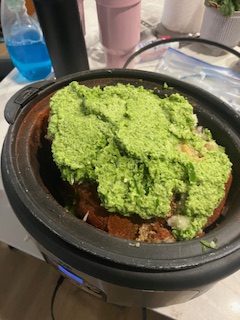
The spices were piled on the pork butt with the jalapenos on top.

Sunday’s lunch was a milestone. Our youngest grandchild was dedicated at church—and while she is currently our only grandchild, we speak of her in terms that suggest a full basketball team is waiting on the bench for the coach to send them in. My daughter and son-in-law were surrounded by family, and the day felt appropriately momentous.

My wife had volunteered to host the meal, and we eventually settled on our signature carnitas. It’s a “start it the night before” kind of meal, which is much kinder to the nerves than trying to crank out chicken on a grill after church. I even snapped a photo of the full crockpot for the family cookbook I’m assembling, blissfully unaware it would be the machine’s final portrait.

The Last Supper (Lunch really, but “supper” sounds more foreboding)

The meal was a triumph. Eleven of us (counting the guest of honor) kept the conversation lively while a significant portion of the carnitas disappeared.

The Great Escape

As the party wound down and the cleanup began, the grace extended to our seasoned crockpot was forgotten. The front panel sticker—the one that actually tells you what the buttons do—finally gave up the ghost and peeled off.

But the real issue wasn’t aesthetic. My wife discovered a pool of carnitas broth on the floor when we got up in the morning. This pork shoulder had more fat than usual, and as it rendered overnight, the broth level rose. The lid no longer sealed tight against the pot. Once the liquid peaked past the dome, the leak allowed the brothy contents to escape.

To the Picnic in the Sky

This crockpot had served us for at least sixteen years. We brought it from Ohio. It outlasted its predecessor, which met its end when I dropped a frozen pork loin into it and cracked the crock clean in two.

Fate—or perhaps a premonition—had intervened a week earlier when we spotted a deal on a slightly larger model at Sam’s Club. With a successor already waiting in the wings, we sent the old crockpot to that great church picnic in the sky.

No gold watch. Just gratitude for sixteen years of carnitas.

Hockey Boy Broth

When we moved to Oklahoma to be near our soon‑to‑arrive granddaughter, we bought a house with space for a backyard hot tub. A few months later: hot tub, pergola, grill, generator — the full “we can survive anything but a direct tornado hit” package. Part of the deal was that my wife would handle the chemicals. This was a great plan until it wasn’t.

Somewhere between the third and fifteenth water test at the pool store, I became the reluctant caretaker of the tub. Over time, I learned enough to keep the water clear and the employees from greeting me by name. I even became a semi‑competent “hot‑tub whisperer,” spraying filters, checking levels, and pretending I knew what alkalinity actually meant. My wife and I enjoyed the tub a few nights a week, letting the jets work on our aging joints. The jets are its whole personality.

Then the hockey boys arrived.

They live with us during the season — not our kids, but “our kids” for those months — and they discovered the hot tub like explorers stumbling upon a natural spring. They didn’t use it constantly, but when they did, they treated it like a giant, silent crockpot. No jets. No circulation. Just two teenage athletes sitting motionless in 104‑degree water, marinating like slow‑cooking briskets.

I tried to explain — gently at first, then with the passion of a man who has seen too many water‑testing printouts — that the jets are not optional. The jets keep the nasties moving. The jets are the sanitation system. The jets are the difference between “spa” and “soup.”

They nodded politely and continued soaking in contemplative silence, scrolling through hockey reels, texting, singing, or simply existing in the tub like two large dumplings. If I’m lucky, I might get thirty seconds of jet activity before they settle back into their preferred mode: simmer.

And that’s when it hit me. Chicken broth. Beef broth. Vegetable broth—all available at Walmart. Human broth? Not on the shelves for a reason. Yet here I am, steward of the simmering teenage stock, responsible for skimming the surface and restoring balance to the backyard cauldron.

Still, as much as I complain — and as much as my wife wishes I’d complain less — I’m glad they’re here. Their presence breaks up the quiet, gives the house a pulse, and reminds us that life is more than routines and chemical levels. I’d rather manage the broth from the hockey boys who live with us for the season than from strangers we don’t love.

So I sigh. Then I smile. Then I go check the chlorine.

Toast, Utensils, and Marital Diplomacy: A Slice of Life

Let’s be honest: the kitchen is not just where we prepare food—it’s where domestic philosophy is forged, sometimes on the blade of a butter knife. In my household, we follow a sacred code: “Help the dishwasher out as much as you can.” It’s a noble creed—one that my wife and I mostly share, with a tiny, chocolate-hazelnut exception.

Toast: The Great Equalizer (Almost)

Both of us are toast fans. (We even had a toast song, but that’s a story for another day—and possibly another genre.) While my heart belongs to a bagel with peanut butter, toast comes in at a very respectable second. My wife? She’s all in on toast, topped with Nutella. Frankly, you can’t go wrong with either.

The Knife Dilemma: Peanut Butter vs. Nutella Protocol

Here’s where the marital kitchen harmony wobbles: the post-spread knife ritual.

  • My method: I lick both sides of the knife clean. Some might call it overkill; I call it preventive maintenance. That knife comes out of the dishwasher so clean, it could double as a dental mirror.
  • My wife’s method: She wipes the knife clean on her toast. Efficient, elegant, but perhaps a smidge too trusting of the dishwasher’s powers.

The Empty-Nester’s Dilemma

Back when the house was full of kids, the dishwasher ran daily, and any rogue Nutella or peanut butter never stood a chance. Now, with fewer meals and fewer cycles, any residue has time to harden into something the dishwasher considers “character-building.”

My Heroic Intervention

This morning, as the Nutella knife was headed for the dishwasher, I sprang into action—tongue first. I gave that knife a pre-wash so thorough, the dishwasher sighed in relief.

Let it be known: if the dishwasher fails to deliver, it’s not for my lack of effort. Some people talk about making sacrifices for their marriage. Me? I just lick the knife.


In summary: Marriage is about compromise, teamwork, and occasionally, making sure your appliances don’t face impossible odds. And if you ever need someone to clean up after toast, you know who to call.