The “I Do” Adoption

My son is getting married in a couple of months. She is wonderful. She is also from a completely different culture than ours, which means we are all, on a fairly regular basis, figuring each other out.

That’s not a complaint. That’s just the truth.

When your kid gets married, you don’t just gain a daughter or son-in-law. You adopt them. Nobody tells you that when your kid says “I do,” you’re quietly saying it too. The vows are theirs. The adoption papers are everybody’s.

We’ve had our share of “whoops” moments. Some of them are hers. Some of them are ours. I’d be willing to bet that on the occasions where I thought she’d missed something, she had a perfectly reasonable explanation rooted in how she was raised — and I just didn’t know enough to ask. I’ve been married for 35 years. I still miss things. The idea that I’d have it all figured out with someone I’ve known for just over a year is ambitious, at best.

To his credit, my son prioritized pre-marital counseling before any of this got official. Smart move for any couple. For a cross-cultural one, it’s close to mandatory.

My wife is better at this than I am. She is more patient, more instinctively gracious, and far less likely to assign fault before asking a question. I am a work in progress. She has been working on that project for 35 years and will probably need a few more. It took me that long to become even slightly less selfish than I was on our wedding day.

We are, in a sense, the booby prize she gets for loving our son. She knew what she was signing up for with him. The rest of us came with the package.

What I do know is that she is trying. She genuinely loves our son. She has put real effort into being part of this family, even when this family probably made that harder than it needed to be. She’s learning us in real time. So are we.

The grace has to go both directions. Different families have different quirks even when they share a culture. When the cultures are genuinely different, you need more runway, more patience, and a willingness to say “I didn’t understand that — can you help me?” without anybody getting their feelings hurt. We are still building that. Some days are easier than others.

When they say “I do,” we all do, a little bit. We’re agreeing to figure each other out. To give grace before assigning blame. To ask before assuming. To remember that someone who does things differently isn’t doing them wrong.

I’ve needed that same grace extended to me more times than I can count.

Welcome to the family. We’re still under construction, too.
The Call That Postponed My Retirement

This is a further explanation of two of the titles included on my “semi-retired” business card. (Dual Format Bookworm and Spousal Support Engineer)

The phone call came two months ago, and just like that, the Summer of ’26 vanished.

It was an offer my wife couldn’t — and, logically, shouldn’t — refuse. A similar role to her current one, fully remote, better pay, working with a well-respected colleague from her past. I wasn’t in the room when she took the call. I heard about it afterward, which is probably how most husbands learn the major plot twists in their lives.

I considered a counterargument. The best I had was “I have over 6,000 books on Kindle and Audible.” Most of them were free. The rest I bought on sale, fully intending to read them immediately. That argument, it turns out, doesn’t hold much water against a high-level role with better benefits. So we pushed the goalposts. Summer of ’29 it is.

To understand why I didn’t put up more of a fight, you have to understand our roles. For 35 years, my wife has been the undisputed Bread-Winner. I’ve made several noble attempts at being a Dough-Winner, but her bread is simply better baked, more plentiful, and has a much more reliable crust.

As we navigated kids, fostering, and a move to Texas, she was the one traveling when the company called. She worked evenings and weekends to make the bosses happy, while I waved from the sidelines — or texted her from the same room to see if she remembered she had a husband. My retirement is technically rock-solid and investment-backed, but it is not the golf-and-slow-coffee variety. It is a series of Supporting Roles. I am the Head of Domestic Logistics, and my CEO just signed a three-year extension.

Here’s the part that gets me. She’ll be home. Physically present, same house, same zip code — and completely unreachable. My wife working remotely is not my wife being available. It’s my wife in a digital fortress with a closed door and four consecutive video calls.

I was hoping to pass the childcare baton this year. Instead, I’ve been re-enlisted. I am currently a specialist in diaper-related hazardous waste management — an unpaid internship with zero upward mobility, but I’m told the exposure is great. By the time 2029 rolls around, our granddaughter will be four and likely helping her mom manage two or more siblings.

Then there are the hockey boys. Another three years of work means another three seasons of high-protein breakfasts and civilized-living lessons. It’s all penciled in. As long as they like toddlers and don’t commit any sins beyond redemption, the house stays full.

So we’re staying in the wind and the Oklahoma heat a little longer. Our local kids will be here at least two more years before their academic pursuits take them elsewhere, which means delaying retirement only adds one year of real extension anyway. I participated in this decision. I agreed it was the right call. My counterargument was weak, and I knew it.

I am a reluctant retiree, but I have people — and one very small person — depending on me most days of the week. I don’t get paid, but that doesn’t mean I don’t get compensated.

I’ll get to those 6,000 books eventually. I just need my wife to retire first.

Values Don’t Retire

My wife and I are somewhere in the foothills of retirement. Not even close to the summit. There are still detours on this road, and honestly, we keep choosing them. We could draw a straight line to the finish — coast, let someone else worry about the spring weather.

But here we are, babysitting a ten-month-old and still figuring out health insurance. And I wouldn’t trade it.

Faith Is a Verb

Every time our kids gather around the table, we say a prayer. That’s not a performance — it’s just what we do. Faith comes up again before the meal’s over, usually more than once. We counsel our kids, married and unmarried, on building something with a Godly foundation. But we learned a long time ago that advice requires a listener. Acting on it? That part belongs to them.

We’re conservative Christians. We attend a church that reflects that — not perfectly, but pretty close. Our kids know where we stand. They also know we can’t believe for them. My granddaughter, as much as I adore her, will have to find her own faith someday. Her parents’ belief won’t carry her across that finish line, and neither will ours. What we can do is make sure the example exists. Doing nothing, after all, is the easiest thing in the world to imitate.

The Tangible Stuff

I’m not going to pretend grandparenting is purely a spiritual exercise. My granddaughter needs a babysitter, and I technically have “spare time” — though I’m not sure where I’m hiding it. My wife works remotely, so we tag-team diaper duty in shifts that would make any grandparent proud.

And yes — her job keeps us from raiding our savings for insurance premiums until we hit 65. These aren’t just financial decisions. They’re the quiet argument I make every day to my kids without saying a word: this is what showing up looks like.

Respect Isn’t Political

Everyone has value. The prisoner. The foster kid. The garbage man. We did foster care for six years — that wasn’t a hobby, it was a conviction. The political lines blur for me here. But the bottom line is simple: treat me and my country with respect, and I’ll meet you with kindness. As a Christian, at a minimum, I owe you a prayer. We’re all sinners. Just not all saved.

Generosity Without the Receipt

Could I give more? Absolutely — most of us could, and I’d be a fool to claim otherwise. We give to causes, including our church. Our kids know we give. They don’t need to know the number. The impression matters more than the invoice.

Commitment Is the Whole Game

Marriage is the biggest bet most people will ever place. We’re honest with our kids about it: it’s not easy. It requires two people willing to grow up and reckon with the fact that their decisions now affect someone else’s life, too. We hold an old-fashioned view on this. A marriage with a Christian foundation is simply better, in our experience. That’s not a lecture. It’s just what we’ve lived.

The Promotion We Didn’t Know Was Coming

Somewhere around the time your kids leave the house, you stop being a parent in the daily operational sense and get promoted — if you’re lucky — to trusted counselor. We’re hoping to earn that promotion unanimously.

We weren’t perfect parents. Our advice isn’t flawless either. But if our kids can feel the gist of how we’ve lived — if they’ve seen our convictions match our words, if they’ve watched our marriage hold — then it’ll be hard for any of them to look back and say, “Nobody told me that.”

You were told. You were shown.

We’re not trying to make our kids into copies of us. We’re trying to make sure they don’t walk into the world without a compass. Call me boring. Just don’t accuse me of raising kids who’ll make the world worse. We fought too hard for that. And if they pass something worthwhile to the next generation of Gruenbaums?

That’s the whole point of the journey.

The Sarcasm Sabbatical

When her dad leaves, it’s just the two of us.

She doesn’t cry. She watches the door for a moment, then turns those big brown eyes toward me like she’s decided I’ll do. I reach out my hand and she puts hers in it. Just like that. No negotiation, no hesitation. She’s in.

I don’t deserve that.

Not because I’m a bad person. But because twenty minutes earlier I was mentally rearranging my morning, calculating what I could still get done with her here. A guy who does that doesn’t deserve to have a ten-month-old place her hand in his like he’s the most reliable thing in the room.

If I could summon any sarcasm in that moment, I’d shut it down fast. It has no place there. She wouldn’t understand it anyway, but that’s not why. It’s because sarcasm requires a little distance, a little edge — and she’s handing me something that has none of either.


Sarcasm has been my first language for as long as I can remember. Not the cruel kind — I want to be clear about that. More like a filter. The world comes in, gets processed, and comes out with a slight lean. A raised eyebrow you can hear.

My wife has spent thirty-plus years either appreciating it or tolerating it, depending on the day. My kids grew up fluent. Visitors to our house occasionally need a translation.

It’s not a defense mechanism. I’ve heard that theory. I just like it. It keeps things from getting too precious. Life has enough earnest moments without me adding to the pile.

I’ve never wanted to be the guy who buries his wit in a bowl of warm oatmeal. Still don’t.


Something is happening, though. I notice it in small doses.

She’s been in my life less than a year and the near daily exposure is doing something to my defaults. I’m slower to reach for the raised eyebrow. Quicker to just… be there.

Some of it is age. Some of it might be spring. I’m leaving room for the possibility that July heat brings it back in full force and this whole reflection was seasonal.

But some of it is the memory problem. I ran on fumes through a lot of my kids’ childhoods. Work, dinner, bedtime — repeat. I don’t have the sequential recall I wish I had. Ask me to walk through any one of my kids’ early years in order and I’m zig-zagging between fragments, hoping the effort knocks something loose.

I’m paying attention differently now. She’s clearing her first-year hurdles and I’m watching every one. Maybe that’s what’s crowding out the sarcasm. Hard to maintain the slight lean when you’re actually trying to catch everything.


I want to be clear about something. I’m not trying to shed the sarcasm. I’m not in recovery.

I like those shoes. I like walking through life as the guy with the quick smile and the wit already three steps ahead. It has served me well. It has made hard things bearable and dull things entertaining. My wife knew what she was signing up for. Mostly.

But a ten-month-old with big brown eyes who puts her hand in mine without a second thought — she’s not asking me to change. She just doesn’t leave room for it. The distance that sarcasm requires isn’t available when someone that small is trusting you that completely.

So for now, in those moments, I put it down. Not permanently. Just in the corner, where I can find it when she goes home.


Her mom picks her up and the house goes quiet in a specific way that it didn’t used to.

I don’t immediately reach for the wit. It comes back gradually, like eyes adjusting to light. By dinner I’m probably back to full strength. My wife would confirm this.

But something lingers. I’m not sure what to do with that yet. Maybe nothing. Maybe it’s just what happens when someone tiny and completely earnest spends enough time in your house.

Ask me again in August. If the heat is up and the sarcasm is fully restored, we’ll call it seasonal.

If not, I’ll let you know.

The Voice (Or: How I Learned to Nag Without Technically Nagging)

This is a further explanation of one of the titles included on my “semi-retired” business card. (Reminder Wrangler)

Somewhere after the last kid left for college, I developed a second voice.

Not a concerning one. Not the kind that tells you to do things. More of a guest narrator. A color commentator for the small, unresolved frustrations of domestic life. Specifically, my wife’s share of them.

It sounds exactly like my wife. Except sassier. And with slightly more self-awareness than she’d probably volunteer on her own.

Here’s how it works. The dishes pile up. Judy is, by longstanding treaty, the designated dishwasher. When the stack starts achieving architectural ambitions, I don’t say anything. I just wander past the sink, tilt my head, and murmur — in a voice that is not quite mine — “I wonder when the dish fairies are coming. You’d think they’d have been here by now.”

She knows exactly what’s happening. She’s been married to me long enough to read the subtext, which is: the dishes need doing. The Voice is just the delivery system. It’s a nag wearing a disguise, and the disguise isn’t even that convincing. But somehow it lands softer than the direct version, and we both know it.

The lamp incident lasted several months. We had a lamp behind the chair. The recliner ate its cord. I asked about a replacement — once, twice, roughly fourteen times over what felt like a minor geological era. When I finally deployed The Voice, it came out as: “Boy, I wish I could remember to buy that lamp. Andy hasn’t mentioned it today, so I guess he doesn’t want it anymore.” She smiled. She did not immediately buy the lamp. But the smile was acknowledgment, which is honestly most of what you’re after.

Then there was the peanut butter and jelly incident. These are the ones that make me regret The Voice’s existence.

I had made warmups — real food, intentional food, food that required actual effort and lived in the refrigerator with the reasonable expectation of being eaten. Judy opened the fridge, considered her options, closed it, and made a peanut butter and jelly sandwich. I watched this happen in real time. I said nothing in my own voice, because my own voice would have had an edge to it that the situation didn’t technically warrant. So The Voice showed up instead.

“I know there are perfectly good warmups in there,” it said, with Judy’s cadence and Judy’s calm, “but the peanut butter and jelly is really speaking to me today. And honestly — Andy probably won’t even notice. He loves to throw uneaten food away.”

She laughed. I felt seen and also slightly ridiculous, which is more or less the emotional signature of a successful Voice deployment. The warmups, for the record, were eventually eaten. By me.

The bedtime reading situation is its own category. We both read before sleep. When she stops first, there’s an announcement — delivered with genuine tenderness but also the logistical clarity of a boarding gate closing — that I should probably wrap it up soon. When I stop first, I roll over and go to sleep. If I’m feeling spirited, I’ll glance over my shoulder and say in The Voice, “Don’t read too long, you know how it keeps me awake,” then pull the covers up with the serene expression of a man who has made his point.

I get sassier as the day goes on. Judy has documentation. By 9 p.m., The Voice has loosened up considerably and is operating with real creative confidence.

My wife is a kinder spirit than me — she has accepted this fully. Not just tolerated it. Accepted it. She even has her own version of my voice, which she deploys occasionally. Her renditions are, I will note, significantly more complimentary than mine. Her version of me seems to be a wiser, more generous person. I’m not sure who she thinks she married, but I appreciate the optimism.

Her responses track pretty cleanly to guilt level and degree of offense. Snoring gets a genuine “I’m sorry.” The dishes get something like, “They are piling up — I wish the dishwasher would come back from vacation.” The lamp gets a smile and a “Yes, I should get to that,” delivered with the calm of a woman who has decided to manage me rather than fight me.

The honest version of what The Voice is doing is this: it’s nagging with the volume turned down and a laugh track turned up. It keeps us from having the same conversation with teeth in it. After enough years of marriage, you develop these little systems — ways of saying true things without making them into a confrontation. The Voice is mine. It is weak camouflage. She sees right through it every time.

And she still seems pleased she married a sassy husband — which, after all these years, I’ve decided to take as a win.

The Head Wag

The whole family has been captivated lately by Ellie’s newest trick. As she prepares to trade crawling for the brave new world of walking, we are bracing for an onslaught of milestones. But for now, we are obsessed with the “Head Wag.”

It started a few weeks ago: a rhythmic, sideways nod that defies easy explanation. To the limited comprehension of the adults in the room, the cause remains a mystery. However, Ellie is a generous performer. If we provide a bit of encouragement—usually by making fools of ourselves with our own awkward head wags—she rewards us with an encore. Sometimes, just a sideways glance and a smile are enough to trigger that little face into motion.

In some cases, the “why” is obvious. In others, it’s a total enigma. Is she defragmenting her hard drive? Is she locking a memory in a little tighter, giving it a shake to ensure it doesn’t leak out of her ears?

That serpentine tongue is occasionally hard to explain, but I find myself wondering about the construction project currently happening behind her eyes. What steps does a baby’s brain take to become the adult brain that has to keep her entertained for the rest of her life?

This quirk isn’t happening in a vacuum. She is zooming through her first year, leaving the adults in a state of perpetual amazement. Our days are filled with a chorus of, “Where did that come from?” and “Did her mom do that?”

Our grandparenting journey will only get more crowded as the family grows. My hope is to catalog these individual quirks while holding onto the memories of what they all share. Perhaps, eventually, we’ll realize they aren’t “quirks” at all—just the universal language of babies being babies. My front-row seat might not be as high-octane as a Saturday at the hockey rink watching our boys, but it keeps me absolutely riveted to the adventure.

The 25-Cent Dividend: A Hockey Billet Dad’s Survival Guide

I wrote this post a few months ago, but as time goes by, it feels almost like yesterday.

With the house filling up with hockey players—all three arrived yesterday—my life has officially relocated to the grocery store. My brain is currently a constant loop of logistical questions:

  • Do I have enough snacks for the kid with the tree nut allergy?
  • Does anyone here survive solely on chocolate milk?
  • Does tortellini count as a “high-performance fuel,” or are we strictly a spaghetti operation?

Between the uncertainty and the sheer volume of food required to fuel teenage athletes, I’ve hit Aldi, Sam’s, Winco, and Costco a combined five times this week. The frequency usually drops once the season gets going and I learn their eating patterns, but for now, I am a professional errand runner.

The Aldi Encounter

My first stop at Aldi this week offered a rare chance to be a decent human being. As I was walking out with my non-bagged groceries (I refuse to pay for bags—it’s the principle of the thing), I saw an older lady parked in a handicapped spot. She was visibly struggling to get out of her car; it was clear she needed something to bear her weight before she could even make it to the cart corral.

As I popped my trunk, I called out, “Just hold on! I’ll bring you my cart as soon as I get it unloaded.”

She looked at me, worried, and replied, “But I don’t have a quarter.”

(Ah, the Aldi quarter—the “annoying” way they force us to return our carts. I get that it saves them from paying someone to chase rogue carts in the parking lot, but I don’t have to like it.)

“Not a problem,” I told her. “Just give me a second to clear this out.”

I backed the cart toward her, handle-first. As she grabbed hold, she sighed, “It is terrible to get old.”

Knowing the truth in that, I just smiled and said, “I’m hoping my kids are there for me when I get there.”

The Payback

Zoom ahead to today.

I walked up to the store, quarter gripped in my hand and ready to claim my cart, only to find one already “checked out.” The previous shopper had left their quarter in the lock.

Now, I could have overanalyzed it, but I chose to take it as a sign. It felt like the carts had orchestrated a small tip for my “General Expenses” fund. I took that shiny coin as a little wink from above—as if God was saying, “I saw what you did the other day. You have your moments!”

If only I could get a few more of those moments… I have a feeling I’m going to need a lot more quarters to get through this hockey season.

Mostly Harmless: A Defense of the Kind-Hearted Annoyance

This is a further explanation of one of the titles included on my “semi-retired” business card. (Reminder Wrangler)

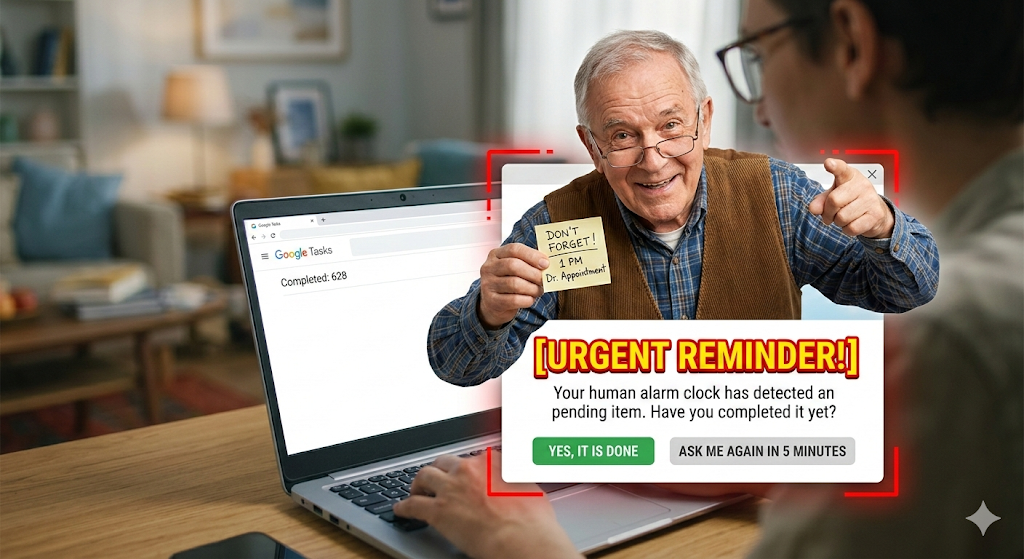
My wife has a habit of looking at me and saying, “Can you remind me to call so-and-so tomorrow?” or “I have a doctor’s appointment; don’t let me forget.”

She seems to believe I have a dedicated “Spouse Schedule” processor running in the background of my brain at all times. In her mind, she’s delegating a task. In my mind, she has just hit “Install” on a piece of high-persistence malware.

Being a human reminder is a high-stakes game. It comes with two distinct curses: the crushing dread of forgetting, and the social suicide of over-reminding.

The “Nag” Sacrifice

Admittedly, smartphones have chipped away at my market share. But even in a world of haptic feedback, I still find ways to offer my “invaluable” services. As I’ve grown older, I’ve become so committed to the role that I have officially slipped into the “nag” category.

I am a human pop-up ad. I am the “Update Required” notification that you can’t swipe away. I have willingly tanked my reputation, descending into that murky social basement occupied by influencers and other bottom-dwellers of the untrustworthy food chain.

Why do I make this sacrifice? Because when she says “Remind me,” it is a binding contract. That initial charge supersedes any later, frustrated comments like, “Okay, you can stop reminding me now!” I bought in until the objective was completed, honey. I’m a shareholder in this phone call now. Why can’t you stay as committed as I am?

The Glory of the Checkbox

I understand she has a full-time job and “life distractions” that are several priority levels above our current joint focus. But for me, the task stays on my mental dashboard until the very last second.

I can’t take it off the list until I look at her and start to open my mouth. Usually, before a single syllable escapes, she snaps: “It’s done. Okay?”

Victory. With that comment, I get to check two boxes. First, the “self-tickler” part of my brain finally stops itching. Second, and more importantly, I go to Google Tasks and watch my “Completed” count climb from 627 to 628. For a semi-retired grandpa, that is a statistical triumph worth celebrating.

Bring Back the Nag

My life isn’t overly complicated, and I like it that way. It’s these small, irritating transactions that give me value.

While your phone may give you a reminder from the cold obscurity of a pocket, you should consider bringing a kind-hearted nag back into your life. We are mostly harmless, we take your chores more seriously than you do, and we only want the best for you—mostly so we can finally stop thinking about your dentist appointment and move on with our lives.

The “Get-To” vs. The “Have-To”

I’m currently coming off a 60-day streak from my other blog, and I’m protective of that momentum. With “Grandpa’s Daycare” eating up about 30 hours of my week, I never truly know which day will be the one where the wheels fall off. My goal for this past weekend was simple: bank a three-day buffer of posts so I could breathe.

I missed that goal by 100%.

It started Saturday at 4:30 AM with an airport run for my wife. Here’s what 4:30 AM looks like: three cars on the road, darkness that makes 7:30 AM look like high noon, and a version of me with zero sarcasm loaded. I’m a sarcastic person by nature — it’s basically my factory setting — but apparently it doesn’t boot up until after sunrise. My wit didn’t come back online until I was halfway home, alone, with no one to appreciate it.

That low-grade exhaustion shadowed me the rest of the day. My son and his fiancée came over for quality baby time, and my job quietly shifted. My future DIL is anxious to start her own family, so when she’s in the room, my grandpa instincts take a back seat. My real role became reading the baby’s cues and redirecting — making sure the DIL banked every possible minute of the Ellie experience she craved. I’m not just watching my grandkid grow. I’m watching my future family grow.

I wasn’t exactly winning “Host of the Year,” but the baby stayed alive, so I’ll call it a win.

Then came Sunday. And the Eggplant Experiment.

My son wanted to make Eggplant Parmesan, which — fine. Noble ambition. The problem was his vision was… limited. One small eggplant will not feed a crowd. Bread it, fry it, done. No sauce. No provolone. No oven time. Now, most of his cooking lives in the Instant Pot or air fryer, clean and contained. Hand him a pan and grease, and you’ve introduced variables: splatter, smoke, and a look on his face that says he’s improvising in real time. Sensing a nutritional void and a quiet anti-eggplant contingency in the house, I scrambled. I resurrected some chicken parm from Thursday night, prayed I could add enough juiciness to make the “recycle” respectable. By then, the endless volley of “Where is the…?” and “How do I…?” questions had made any hope of retreating to my den to bank those blog posts evaporate.

Dinner blurred for me. After the dishes were cleared, my reward for the day was another airport run to pick up my wife. I felt a little guilty about leaving the house mid-activity, told the kids so, and then spent the drive enjoying fifteen minutes without anyone asking me where anything was. Getting her home before 8:30 PM is a world better than an 11:00 PM pickup. Some wins are quiet.

Later, sitting with zero banked posts and approximately zero relaxation, I chewed on that question from my future DIL — something rooted in our faith, about whether certain things we’re called to do feel more like obligation than privilege. “Do you get it?” The contrast she was drawing: some things in the Christian life aren’t always fun, but with the right mindset, you get to participate in something most people don’t even realize is available to them.

As I thought about this question, I reviewed my weekend. Do I get it?

Yes. I get a life so full of stories I don’t have time to write them all. I get to be a dad and a granddad multiple times a day. I get to cook for people I love — and not every time I do, do I feel grateful, I’ll be honest. But if I have to cook anyway, I might as well frame it as a “get to” rather than a “have to.” The food tastes the same either way. The choice is just which version of yourself shows up at the table.

When you’re exhausted, it can all feel like a “have-to.” But it’s a “get-to” that most people would pay a premium for.

Grills, Grandkids, and the Smoke Detector Saga

The Great Grill Misstep

Last night started innocently enough: we grilled up a feast of brats, hamburgers, and some andouille sausage. As usual, after taking the meat off the grill, I cranked up the heat to incinerate any lurking germs. It’s my personal version of a germ exorcism. Normally, I remember to turn the grill off afterward. Normally.

Fast-forward 18 hours. I’m feeding my granddaughter a bottle, gazing out the back window like a serene caretaker, when my brain suddenly asks, “What are those heat ripples coming off the grill?”

Cue the realization.

I stepped onto the porch, and it hit me like a ton of bricks: I never turned the grill off. The gas knobs were still wide open, and when I lifted the lid, I was greeted by a mountain of white ash. My grand plan to “clean it later” was quickly followed by a mental debate: Do I tell my wife about this? Spoiler alert: keeping secrets isn’t my strong suit.


Smoke Alarms: The Plot Thickens

Barely an hour later, with my granddaughter swaddled and happily snoozing in her crib (a rare victory in our new “Grandpa’s 30-hour-a-week daycare” schedule), I finally sat down at my computer. That’s when it happened. The smoke detectors went off.

At first, I thought, Oh no, not this again. A few months ago, we had a smoke detector malfunction, and the screeching symphony was unforgettable. Hoping for a quick resolution, I checked the baby—still sound asleep—and sat back down.

Then the alarms screamed again.

The baby stirred, letting out a pre-nap protest, while my heart sank. Time to play Smoke Detector Roulette. Armed with a ladder, I started disconnecting units. Which one of the seven is the ringleader? Who’s the boss of this noise parade?

Two attempts later, I finally silenced the screaming. Relief washed over me. Then paranoia set in: What if this wasn’t a malfunction? I rushed to check on my granddaughter. No signs of carbon monoxide poisoning. She woke up soon after, demanding bottle number two, blissfully unaware of Grandpa’s mini heart attack.


The Reconnection Gamble

Once the baby was settled, it was time to reconnect the smoke detectors. Hooking them back up wasn’t the hard part—my fear was that one rogue detector would throw a tantrum in the middle of the night. And let’s be honest, my “middle-of-the-night hugs” are more like aggressive shoves.


Theories and Lessons

So, what triggered all this chaos? My best guess is that the unvented grill might’ve released something the detectors didn’t like. Or maybe it was dust. Or humidity. Or, let’s face it, the universe just wanted to spice up my day.

Whatever the cause, I’d like to file a formal request with the smoke detector gods: next time, can you schedule your shenanigans around the baby’s nap?


In the end, I learned two things: always double-check the grill, and never underestimate a smoke detector’s ability to keep life exciting—even if it’s at the worst possible moment.