Amen Ambassador

This is a further explanation of one of the titles included on my “semi-retired” business card. (Amen Ambassador)

I’ve been involved with a program called “Let’s Start Talking” (LST) for a good number of years now. My daughters and I even trekked to Hungary almost a decade ago for a mission trip under their banner, but my real “boots on the ground” work happens right here at my desk with my “readers.”

What exactly is a “reader”? In my case, it’s a revolving door of international men who want to polish their English. Before COVID, this involved actual human contact at coffee shops or libraries. These days, it’s mostly me staring at a webcam. We use LST materials that cleverly disguise English challenges—like the dreaded verb conjugation—inside biblical lessons on sin, grace, and salvation.

I’ve worked with men from Saudi Arabia, Egypt, Vietnam, and Ecuador(all pre-Covid and in person). I’ve learned about their customs, tasted their food, and generally enjoyed the “armchair traveler” lifestyle. I did have one female reader from Hungary once (early-Covid), but that taught me a lesson in boundaries. She was preparing for marriage and telling me things about her fiancé that made me want to bail out of the conversation. I figured any marital advice she needed should come from a woman, not me. I arranged a “handoff” to a female teacher, but she apparently wasn’t a fan of the trade. She never showed up again, though I see her on Facebook with a baby now, so she clearly survived my attempt at mentorship.

The Current Roster I currently have three regulars. They are all academically driven, though their personalities couldn’t be more different:

  • The Long-Hauler (Asia): I’m keeping his specific country a mystery to avoid any international incidents. We’ve been at this for five years. I’ve “walked” with him through a doctorate in Europe and watched his son grow up via pixels. We spend 40 minutes talking about everything from personal pictures to politics before I “cherry-pick” devotions that contain enough big words to keep him on his toes.
  • The Enthusiast (Brazil): He’s been around for about four years. He is the walking definition of the Brazilian stereotype—emotional, enthusiastic, and loud. He’s met my granddaughter on Zoom (he asks about her every call), and I’ve met his mother. She doesn’t speak a lick of English, but she’s promised me a world-class meal if I ever show up in her kitchen. He is a fantastic, high-energy contrast to my more reserved Asian reader.
  • The Academic (Poland): He started with me in high school and is now a university student. He’s an only child who passionately describes every meal and movie in his life. Because of the age gap, I have to work a little harder to stay “relatable” (pray for me). He’s Catholic by heritage but mostly just a moral guy with no real interest in faith. I keep showing up anyway. Even if the conversations aren’t always “deep,” we both usually learn something by the time the timer hits zero.

The Logistics of Grace Aside from “showing up,” the hardest part of being an Amen Ambassador is basic math. Keeping track of time zones is a nightmare. Europe changes their clocks on a different schedule than the US, and my Asian and Brazilian readers don’t change their clocks at all. I much prefer the 9:00 AM meetings over the 8:00 AM ones—mostly because my brain functions significantly better with that extra hour of blood waking it up.

Could I do more? Probably. But at this stage, my wife and I have agreed that our own kids and grandkids are our primary mission field. We’re working to give them a foundation that won’t crack when life gets messy. If I’m held to account on the other side of the grave, I’ll be fine knowing my family came before any other “mission goals” I might have entertained.

God might have other things He’d like us to take on, and those may have to live in the “regret” folder of my mind for now. But I refuse to let my family be part of any regret.

Mostly Harmless: A Defense of the Kind-Hearted Annoyance

This is a further explanation of one of the titles included on my “semi-retired” business card. (Reminder Wrangler)

My wife has a habit of looking at me and saying, “Can you remind me to call so-and-so tomorrow?” or “I have a doctor’s appointment; don’t let me forget.”

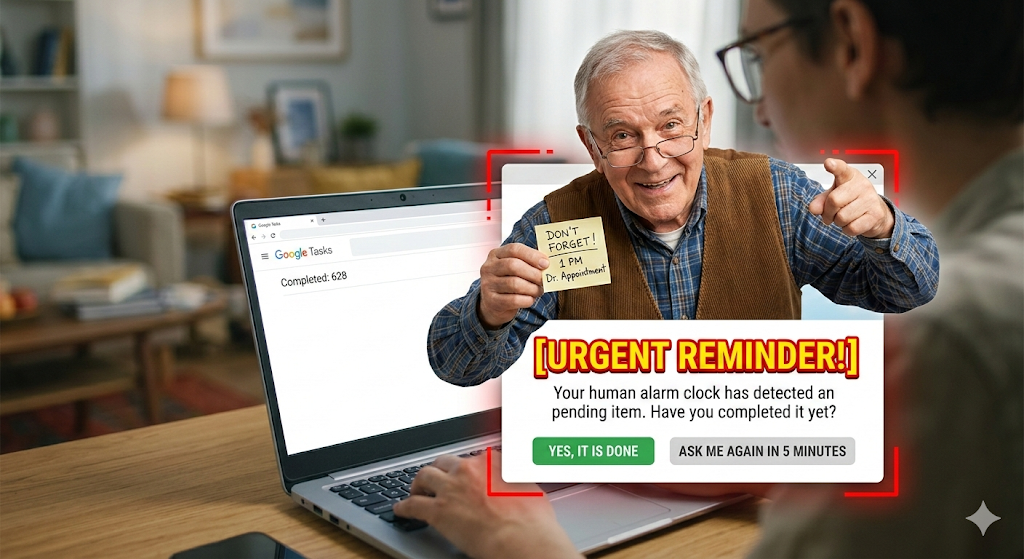
She seems to believe I have a dedicated “Spouse Schedule” processor running in the background of my brain at all times. In her mind, she’s delegating a task. In my mind, she has just hit “Install” on a piece of high-persistence malware.

Being a human reminder is a high-stakes game. It comes with two distinct curses: the crushing dread of forgetting, and the social suicide of over-reminding.

The “Nag” Sacrifice

Admittedly, smartphones have chipped away at my market share. But even in a world of haptic feedback, I still find ways to offer my “invaluable” services. As I’ve grown older, I’ve become so committed to the role that I have officially slipped into the “nag” category.

I am a human pop-up ad. I am the “Update Required” notification that you can’t swipe away. I have willingly tanked my reputation, descending into that murky social basement occupied by influencers and other bottom-dwellers of the untrustworthy food chain.

Why do I make this sacrifice? Because when she says “Remind me,” it is a binding contract. That initial charge supersedes any later, frustrated comments like, “Okay, you can stop reminding me now!” I bought in until the objective was completed, honey. I’m a shareholder in this phone call now. Why can’t you stay as committed as I am?

The Glory of the Checkbox

I understand she has a full-time job and “life distractions” that are several priority levels above our current joint focus. But for me, the task stays on my mental dashboard until the very last second.

I can’t take it off the list until I look at her and start to open my mouth. Usually, before a single syllable escapes, she snaps: “It’s done. Okay?”

Victory. With that comment, I get to check two boxes. First, the “self-tickler” part of my brain finally stops itching. Second, and more importantly, I go to Google Tasks and watch my “Completed” count climb from 627 to 628. For a semi-retired grandpa, that is a statistical triumph worth celebrating.

Bring Back the Nag

My life isn’t overly complicated, and I like it that way. It’s these small, irritating transactions that give me value.

While your phone may give you a reminder from the cold obscurity of a pocket, you should consider bringing a kind-hearted nag back into your life. We are mostly harmless, we take your chores more seriously than you do, and we only want the best for you—mostly so we can finally stop thinking about your dentist appointment and move on with our lives.

The Morning Scrimmage: Why Every Marriage Needs a “Billeted” Punching Bag

My wife and I have been married for nearly 35 years, and I’ve learned one absolute truth: Marriage isn’t just about love; it’s about managing the “chirps.”

I am a natural-born chirper. If I have a witty observation or a mild grievance, it bounces around my skull like a puck rattling around a dryer drum until it finds an exit. My wife, however, is a “slow-thaw” morning person. She is not a fan of dialogue—and certainly not banter—until she’s well into her second cup of coffee.

For the sake of our domestic harmony, I have to get those chirps out of my system without bumping into her morning rhythm. Fortunately, we have “The Boys.”

The Peanut Butter Defense

Currently, our kitchen is populated by billeted hockey players. They are the perfect targets. They provide the friction I need to reach my “optimum flow” without waking the dragon — my wife, who is lovely precisely because she hasn’t spoken yet.

Take, for instance, the “Bagel Bandit.” This kid has a specific talent for “nutty perfection.” He’ll smear peanut butter on a bagel and then, as a final flourish, leave a thick glob on the knife before dropping it in the sink. Within minutes, that peanut butter undergoes a chemical bonding process that makes it “dishwasher-proof.”

On a morning when my wife is still on her first cup, I’ll drop a line on the Bandit:

  • “The dishwasher is a machine, son, not a miracle worker. Clean the blade.”
  • “If you lick that knife clean, the dishwasher will thank you for your service.”

The “Agile” boys—the ones with a high hockey IQ—will fire back. The “Slow-Mo” rookies just nod and say, “Okay, next time,” while they internally calculate how many minutes until practice.

The Buffer Zone

There is a method to my madness. My wife knows I like to banter, and as long as I don’t go too hard on the kids, she lets me run my plays. In fact, she’s grateful. By the time she’s ready for conversation, I’ve already burned off my sass on a 19-year-old defenseman.

The boys are the grease that keeps the marriage rolling through the years. When my wife is an “obstacle” to my flow—meaning she just wants to eat her toast in peace—the hockey boys step in to cover the difference.

The Sentiment in the Sarcasm

I’ll admit, the sentimental side of this gets hidden under the layers of trash talk. But it’s there. My wife gets the lion’s share of my heart, and whatever is left over goes to these boys who have become part of our daily chaos.

We had a visitor the other day who mentioned he does the dishes for his billet mom because she’s been ill. I looked at my most “agile” resident and asked if he’d ever consider such a noble act.

He didn’t miss a beat: “Well, if you were gravely ill, I might consider it. But since you’re healthy, I guess I’ll just keep letting you sharpen your wit on my dish-loading skills.”

After he made his comment, we exchanged a glance. We both knew the chirping wasn’t entirely one-sided.

The Long Game

How long will we keep these “billeted victims (their term, not mine)”  around? Only until the grandchildren are old enough to hold their own in a verbal sparring match. I need a house full of relatives with finely honed wits to keep me humble.

Until then, I’ll keep chirping at the boys. It keeps my mind sharp, the sink (mostly) clear, and my 35-year marriage exactly where it needs to be: in a state of graceful, quiet, peanut-butter-free peace.

A Eulogy For My Father

My father was a man of few words, but his influence on me was profound. He taught me the value of hard work and dedication and showed me how to be a kind and thoughtful person.

From him, I learned that no matter what life throws at you, it is important to stay positive and keep moving forward. He also showed me how important it is to be true to yourself and stay humble even in the face of success. His belief that we can always learn from our mistakes has been one of my guiding principles.

My dad was an amazing role model, teaching me about perseverance, fairness, and respect for others. Even when faced with adversity, he always managed to keep his head up, setting an example that I strive to follow every day. He also shared his love of gardening and plants, which I still enjoy.

I am grateful for all the lessons he taught me during our brief time together. It is hard to believe he has been gone for 37 years. As I have come into adulthood more fully and heard various stories about him from all across the spectrum, I hope the stories told about me when I am gone will paint a consistent picture.

His loss has left an emptiness in my life, but I take comfort in knowing that his legacy will live on through everything he passed down to me and my siblings — his values, strength, and unwavering sense of duty.

While my earthly father has been gone many years now (37 as of 2 days ago), I pretend he looks down on me occasionally and says, “There is my oldest son. He has done okay.” Since my religious beliefs don’t subscribe to “my earthly father” looking down on me, I hope my Heavenly Father knows me and that I seek his influence daily.

I am glad to have the father I did. Once he and my mother allowed me to pass into adulthood, the world attempted to claim me for its own. I am grateful my Heavenly Father did not allow that to be so. It is to Him I hope my life eulogizes.